

Karoline Lewis, professor at Luther Seminary and a great lover of John’s Gospel, was the speaker at the Large Church pastors gathering a few weeks ago, and she shared something in her presentation that really struck me, and I wanted to share it, especially as another academic year has come to a close and this particular configuration of Wartburg Theological Seminary is dissolving. When we reconvene this fall, we will welcome new members, and at the same time, we will feel the absence of those we said goodbye to this spring.
So, it is a good time to talk about being connected, and being held.
Now, I have to say that, in spite of Professor Lewis’ affection, John’s Gospel is not my favorite. However, one thing I will say about John’s omniscient and uber-in-control Jesus is that he cares deeply about relationship, and about connection. John’s Jesus lives fully and firmly out of his relationship with his Father—the relationship a beloved son has with his cherished parent. And, in his very wordy farewell discourse, he invites us into that intimacy as well: the father to Jesus, Jesus to us, us to the Parent—closer than close.
We are bound together, wound together through the loving weaving of the Holy Spirit. And not only are these threads that the Spirit spins unbreakable, they stretch across time and space. These fibers vibrate with her breath—one beating heart to another.
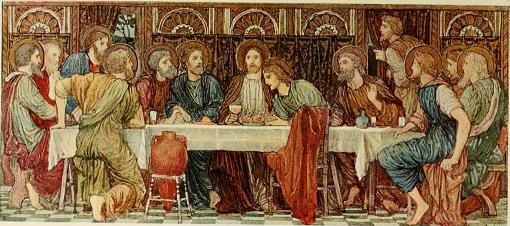
In John’s account of the Last Supper, we see these fibers both pulled tight and stretched to their limit simultaneously. One disciple, the “beloved disciple,” resting his head on Jesus’ own body, other disciples sitting close to Jesus at the table, one disciple ignorant of his impending denial, and one disciple already gone, on the cusp of his betrayal. And yet, they are all bound together.
So with us, too. John’s Jesus goes to great lengths to assure us that the bonds between Jesus and us will hold: beyond his death, beyond his resurrection, and beyond his ascension. And, the bonds between us will hold: beyond division, beyond disagreement, beyond distance and beyond difficulty. And to be clear, these threads will hold, because they have a divine artist; they are not dependent upon our skill, or our strength. Their weave is tight, and true; and their pattern is beautiful—and one of a kind.
There is a lovely image that this Gospel writer uses to reinforce the intimacy of our relationship with Christ, and it is this image that I want to leave you with, dear reader, as you move forward into the summer, and perhaps into a transition of your own.
In two—and only two—places in the Gospel of John, the Greek word καλπος is used. In both places, it is translated as “heart”—and it is meant to indicate the intimacy of a relationship. We read it first in chapter 1, where it describes the relationship between the Father and the Son. Verse 18 reads, “No one has ever seen God. It is the only Son, himself God, who is close to the Father’s heart, who has made him known.” And then it comes again in John’s telling of Jesus’ final meal with his disciples. Chapter 13, verse 23 reads, “One of his disciples—the one whom Jesus loved—was reclining close to his heart….”
But this word καλπος actually means “bosom,” and so the image here is of two persons who are about as close as it is possible to be. Jesus is this close to the Father, and this “beloved disciple” is this close to Jesus. In her presentation on this text, Professor Lewis said that while there has been much speculation about who, exactly, this beloved disciple is, the meaning in John’s Gospel is clear: we are this disciple. I welcome this image of you, me, each one of us as the beloved disciple, resting our head on Christ’s bosom, on Christ’s chest.
In sharing this interpretation with us, Professor Lewis told us her own story of this closeness. One of her sons, who was born premature, needed to stay in the NICU until he was strong and healthy enough to go home. And, as many of us know, one of the most important ways that this growth happens for these very tiny babies, is through “kangaroo care.” This is when the baby is placed on the bosom of the mother and the father, skin to skin, and is held there—just held there, feeling the warmth and the love of their parents.
In John’s Gospel, we, God’s children, are invited—encouraged, even—to imagine ourselves held in this way: so tightly, so warmly—with such love and care. In whatever comes for you in the next weeks and months, I hope you feel yourself held with this love; and I pray that we might share this love with others as well.


