
The Pope’s Two Building Projects
“Now the whole earth had one language and the same words. And as they migrated from the east, they came upon a plain in the land of Shinar and settled there. And they said to one another, “Come, let us make bricks and fire them thoroughly.” And they had brick for stone and bitumen for mortar. Then they said, ‘Come, let us build ourselves a city and a tower with its top in the heavens, and let us make a name for ourselves; otherwise we shall be scattered abroad upon the face of the whole earth.’ The Lord came down to see the city and the tower, which mortals had built. And the Lord said, ‘Look, they are one people, and they have all one language, and this is only the beginning of what they will do; nothing that they propose to do will now be impossible for them. Come, let us go down and confuse their language there, so that they will not understand one another’s speech.’ So the Lord scattered them abroad from there over the face of all the earth, and they left off building the city. Therefore it was called Babel, because there the Lord confused the language of all the earth, and from there the Lord scattered them abroad over the face of all the earth.” Genesis 11:1-9
“So I came to Jerusalem and was there for three days. Then I got up during the night, I and a few men with me; I told no one what my God had put into my heart to do for Jerusalem. The only animal I took was the animal I rode. I went out by night by the Valley Gate past the Dragon’s Spring and to the Dung Gate, and I inspected the walls of Jerusalem that had been broken down and its gates that had been destroyed by fire. Then I went on to the Fountain Gate and to the King’s Pool, but there was no place for the animal I was riding to continue. So I went up by way of the valley by night and inspected the wall. Then I turned back and entered by the Valley Gate and so returned. The officials did not know where I had gone or what I was doing; I had not yet told the Jews, the priests, the nobles, the officials, and the rest who were to do the work. Then I said to them, ‘You see the trouble we are in, how Jerusalem lies in ruins with its gates burned. Come, let us rebuild the wall of Jerusalem, so that we may no longer suffer disgrace.’ I told them that the hand of my God had been gracious upon me and also the words that the king had spoken to me. Then they said, ‘Let us start building!’ So they committed themselves to the common good. Nehemiah 2:11-18
If you have read (or skimmed, which is justifiable—it is LONG) Pope Leo XIV’s recent encyclical, Magnifica humanitas: On Safeguarding the Human Person in the Time of Artificial Intelligence, you know that these two readings anchor his argument. You can read it here: https://www.vatican.va/content/leo-xiv/en/encyclicals/documents/20260515-magnifica-humanitas.html
The very first sentence of this encyclical reads as follows: “Humanity, created by God in all its grandeur, is today facing a pivotal choice: either to construct a new Tower of Babel or to build the city in which God and humanity dwell together.” In the introduction, Pope Leo goes on to describe the context of the “res novae” of our time: contemporary technological advances—in particular, AI. In this moment, he argues that, “crucial questions impose themselves on our conscience and can no longer be avoided: Where are we going? Toward what goal do we wish to orient ourselves? What direction should we choose as a people and as a human community?”
What are We Building?
From these questions, he makes the transition to what will be a very long answer; and to begin that answer, he introduces these two biblical images that provide the contrast he will use to illustrate the way he wants humanity to go: the construction of the Tower of Babel, or the rebuilding of the walls of Jerusalem. He describes the contrast this way: “On the one hand, there is the Tower of Babel, where collective effort follows a plan that dominates and ultimately dehumanizes. On the other hand, there are the ruins of Jerusalem, which under Nehemiah’s direction are rebuilt piece by piece as a project of shared responsibility.” For Pope Leo, this contrast urges us to ask, “What are we building?”
That is the question I want to reflect on: What are we building?
Now certainly, there are some things to critique in this juxtaposition, especially with the lionization of Nehemiah as an exemplar of inclusivity. We know that both Ezra and Nehemiah already have been clear that not everyone is welcome to participate in this rebuild of the city. But that is a different post.
Instead, here, I want to lift up a few key points from the encyclical that help us understand aspects of our current context that both support and challenge our ability to build a good society together; a society that is good for all.
Good for a few just isn’t good enough.
First, I want to celebrate and amplify Pope Leo’s explicit critique of “the idolatry of profit” and the emphasis on the gifts of diversity, and shared work, where everyone’s gifts have a role to play in the support of the common good. We start where we are, in the spaces and places in which we find ourselves.
I think we have all experienced that, in our current climate, the temptations toward divisiveness, disrepair, and disregard for the other are very strong. An eye for an eye mentality is widely encouraged, along with a vengeful spirit of retribution and increased cronyism that fosters an in-group mentality to the detriment of those on the outside: the newcomer, the vulnerable and the under-resourced.
Pope Leo notes how there is a danger that the “digital goods” of patents, data, and platforms remain “concentrated in the hands of a few, without adequate forms of sharing and access.” This widens the gap “between those who can participate in the digital revolution, and those who remain on the margins.” The amazing technological advances that we are currently experiencing must be for everyone, and they must support the well-being of all, not just the rich, not just those in certain countries, and not just those with easy access.
He writes that, in the digital age, a just social order is essential. Only such a system “guarantees everyone equal access to opportunities, protects the youngest and weakest members of society, combats hate and misinformation, and subjects the use of data and technology to public oversight, so that the guiding principle is not solely profit, but the dignity of every person and the common good of all people.”
What else can you say to that but amen and amen?
Related to that, he reminds us of the importance of the treatment of migrants and refugees. Again, he writes: “The way a society treats them reveals whether its sense of justice is driven by fear or by the spirit of fraternity.” And here he repeats Pope Francis’ words, who urged us to see migrants “not simply as a problem to be managed, but as a living image of the People of God on the move.” That is such a beautiful phrasing.
We know that we also live in a climate where fear is being fostered, actively encouraged, which drives us into our reptilian brains. This makes us suspicious, accusatory, stingy and defensive. These are qualities that tear down, and make building the common good increasingly difficult.
The encyclical also includes a very nuanced and thoughtful discussion of A in chapter 3. I have been reflecting on his contrast between artificial “intelligence” and the “intelligence” of human beings, which he describes in this section. I want to quote him at length here, because I think his description (in paragraph 99) is so rich and thought-provoking:
These systems merely imitate certain functions of human intelligence. In doing so, they often surpass human intelligence in speed and computational capacity, offering tangible benefits across many fields. Yet this power remains entirely tied to data processing. So-called artificial intelligences do not undergo experiences, do not possess a body, do not feel joy or pain, do not mature through relationships, and do not know from within what love, work, friendship, or responsibility mean. Nor do they have a moral conscience, since they do not judge good and evil, grasp the ultimate meaning of situations, or bear responsibility for consequences. They may imitate language, behavior, and analytical skills, or even simulate empathy and understanding, but they do not understand what they produce, for they lack the affective, relational and spiritual perspective through which human beings grow in wisdom. Even when these tools are described as capable of ‘learning’, their way of doing so is different from that of a human person. It is not the experience of those who allow themselves to be shaped by life and grow over time through choices, mistakes, forgiveness, and fidelity. Rather, it is a form of statistical adaptation based on data and feedback, which can be very effective, but does not imply inner growth.
I have found it both instructive and meaningful to reflect on how the ways in which we understand AI can shed greater light on the uniqueness of the human person, and the value of human beings, human relationships and human wisdom. A great example of this is the way Pope Leo talks about limits. He notes: “Everything that appears as a limit—incapacity, illness, old age, suffering, vulnerability—tends to be seen primarily as a defect to be corrected, rather than as a reality through which our humanity matures and opens itself to relationship.” Human beings are finite beings, and no amount of technology can or should change that, even as we can and should always seek to mitigate suffering and anything that compromises the flourishing of authentic human life.
I want to end where the cyclical ends, which is with the Magnificat, what he calls “the song of hope.” He writes: “With the same faith as Mary, let us become ‘weavers of hope’ in our world, sharing who we are and what we have, so that the presence of Jesus may grow among us and his Kingdom take shape. In the humble fidelity of daily life, even the era of AI can become a time in which the Holy Spirit brings about the civilization of love in our lives.”
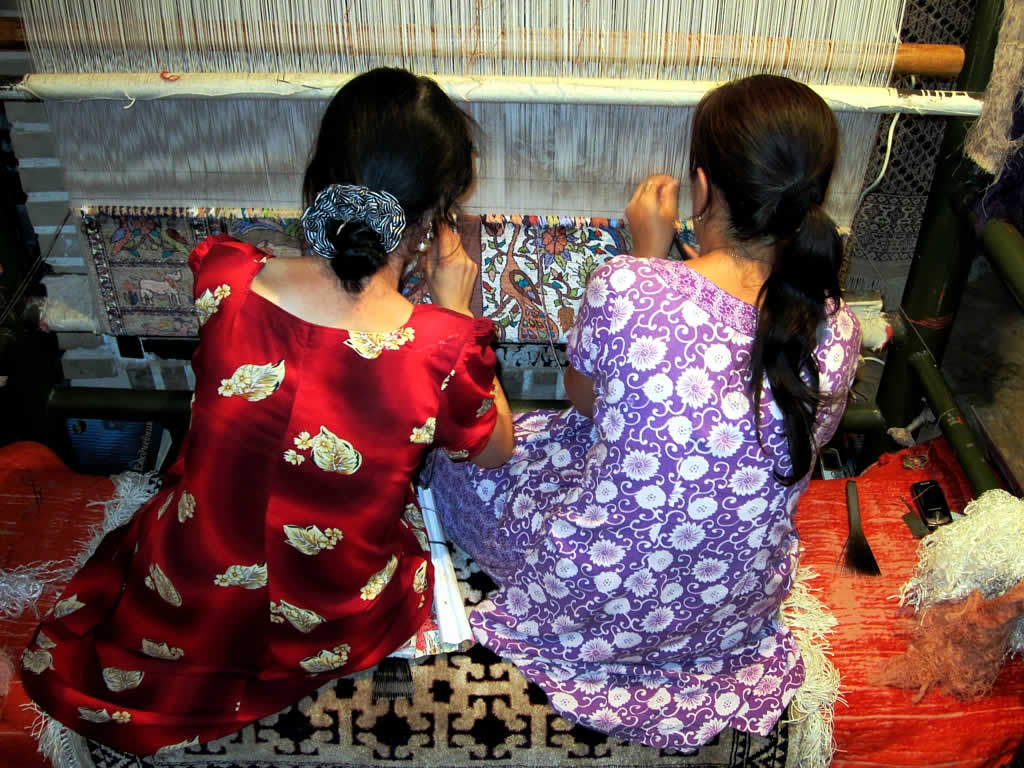
May together we continue to weave a beautiful tapestry of love, grace and mercy (and hope!) with the colorful threads provided by the Holy Spirit, given equally and generously to each and every one of us.


