

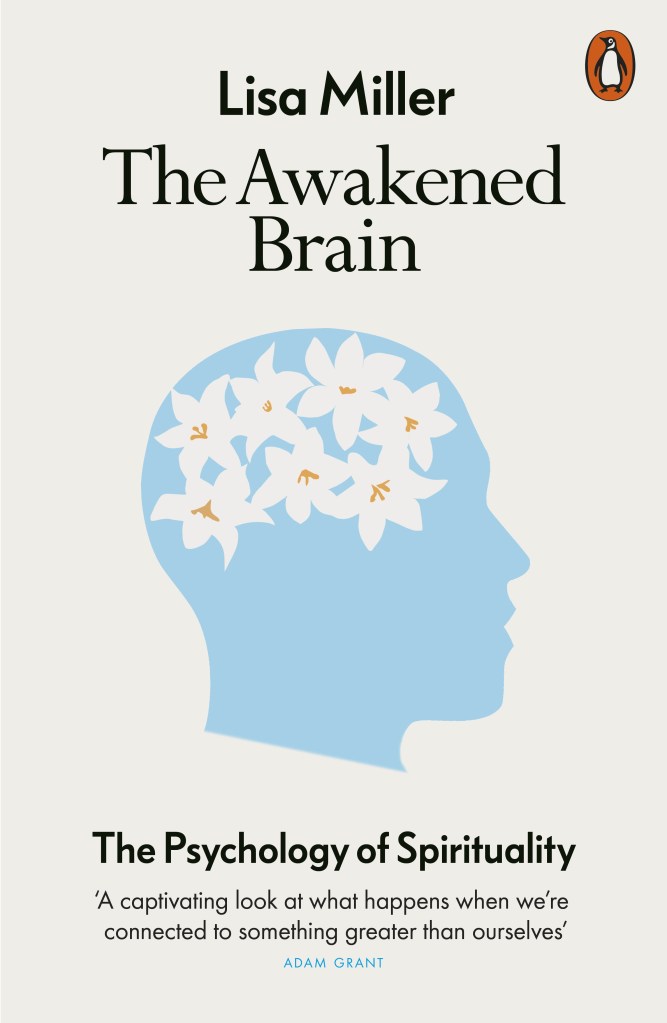
I just finished a really interesting book and I want to share it; I hope you find it interesting, too—and maybe it will even inspire you to look at the world (and yourself) a little differently.
The title of the book is The Awakened Brain, by Lisa Miller. Dr Miller is Professor of Psychology at Columbia University and has a joint appointment in the Department of Psychiatry at Columbia Medical School. The subtitle of the book is “The Psychology of Spirituality,” which tells you much you need to know about the book.
The brief summary of the book is that extensive research into brain science proves that we are hardwired for spirituality (which is different from religion). She writes that “each of us is endowed with a natural capacity to perceive a greater reality and consciously connect to the life force that moves in, through and around us” (7). Further, we can develop and strengthen this capacity, which not only helps us live a more meaningful, connected life, but also protects us against depression, hopelessness and isolation.
This brain is the awakened brain—as opposed to the achieving brain. More about that shortly.
This is how she describes the awakened brain:
The awakened brain includes a set of innate perceptual capacities that exist in every person through which we experience, love and connection, unity, and a sense of guidance from and dialogue with life. And when we engage these perceptual capacities—when we make full use of how we’re built—our brains become structurally healthier, and better connected, and we access unsurpassed psychological benefits: less depression, anxiety, and substance abuse; and more positive psychological traits, such as grit, resilience, optimism, tenacity, and creativity (9).
Before I say more about her research, let me say more about how she differentiates spirituality from religion. She emphasizes that these are two different things. Religion is environmentally conditioned, based on where and how one is raised. By contrast, spirituality is an inner sense of connection to a higher power and the universe itself, a sense of being loved and cared for, and a belief in meaning in the world and in one one’s own life. As I said, we are hardwired for spirituality, but religion is something different. As a Christian, I believe that there are Christian practices that support the development of the awakened brain, such as prayer, meditation, communal worship, etc., but Christianity is not the only place such practices are found. Dr. Miller makes clear that even those who do not belong to any religious tradition can be “spiritual”—at least, in the way she describes in the book. As someone who has always looked down my nose a bit at the idea of “spiritual but not religious,” I found this distinction helpful and constructive.
She begins the book describing her early experiences working in a mental health ward in New York City, and becoming disillusioned with treatment of the patients, which focused almost exclusively on medication and psychoanalysis. Her frustration came to a head when she led a small Yom Kippur service, in which the small group of patients were calmer, more relaxed and experienced genuine communion. She began to wonder if spirituality might hold the key to a different way of approaching mental health and healing, and this curiosity began the road of inquiry that led to the conclusions she describes in this book.
I don’t have time (or the knowledge really), to explain all the science in the book, so let me summarize in a couple quick points:
- A strong spiritual life is shown by thickness in the brain’s right cortex (and by contrast, thinness correlates with depression).
- “The ventral attention network is where we see that the world is alive and talking to us; the frontal temporal network is where we feel the warm, loving embrace of others end of life itself; and the parietal lobe is where we know that we matter, belong, and are never alone” (162).
- Spiritual experiences are visible in the brain in three significant ways (161): an involuntary re-orientation of attention, a sense of love or embrace, consistent with intimate attachment or bonding, and a sense of self that is both distinct and part of the greater oneness.
From those findings, here are some of her main insights.
What her research discovered is that, in the brain, spirituality and depression are two sides of the same coin, with an inverse relationship. High levels of spirituality—again, which can be documented with an MRI—equates to lover levels of depression. Another way of saying this is to say that a stronger sense of personal devotion—a sense of personal relationship with a higher power—buffers against stressful situations.
Without denying the existence of severe depression that absolutely requires and responds well to medication, it is also true that all depression is not the same. [For example, she describes dysthymia as the low-grade feeling that life is unfulfilling. It’s the work of the achieving brain—conditioning us to seek more: the next job, more success, more money, etc. It is never enough and nothing fully fills the emptiness or the lack of meaning” (25)]. She observes that sometimes depression is a response to a difficult life event, which then becomes a go-to response, a pattern that it is hard to break (119). Not every situation needs medication: sometimes we need a new way of engaging in the world, and we need to develop our “spiritual” brain muscles.
Recognizing and activating the awakened brain changes our entire life—our engagement with the world, our interactions with others, our own sense of self—in so many significant ways.
For example, activating our spiritual brain opens us to “synchronistic moments”—the experience of cohesion between one’s inner and outer life, and the connections between seemingly disparate events (Christians sometime call these “God moments”). The more we pay attention to them, the more we see them.
Also, she notes the difference between “top-down attention,” which excludes irrelevant information and keeps us focused on our goals (a hallmark of the achieving brain), and “bottom-up perception,” which is open to all that is there: being aware and seeing what is there, not filtering down based on a goal (95). This is what enables us to see random encounters as meetings with “trail angels,” those strangers who come into our lives, as we are walking an unknown and difficult path, who support us and remind us that we are not alone.
Let me end with this final observation, which really sums up her argument well:
“Achieving awareness is the perception that our purpose is to organize and control our lives.” By contrast, “when we engaged our awakened awareness, we make use of different parts of our brain, and we literally see more, integrating information from multiple sources of perception. Instead of seeing ourselves as independent makers of our path, we perceive ourselves as seekers of our path. We look across the vast landscape and ask: What is life showing me now? This awakened awareness allows us to perceive more choices and opportunities available to us, feel more connected with others, understand the relationships between events in our lives, be more open to creative leaps, and insights, and feel more in tune with our lives, purpose, and meaning….I still have wishes and desires and goals, I still experience disappointment and hurt but I lean into the flow of life, paying attention to where doors open and close” (164-165).
I could say so much more about this great book, but I think you get the idea. It really opened me up to thinking more about the choices I make, and the way I choose to see the world: what I value, what I give my time and attention to, and what I trust. And, ultimately, why my faith matters so deeply to me. It makes all the difference.

 Happy Lutheran