
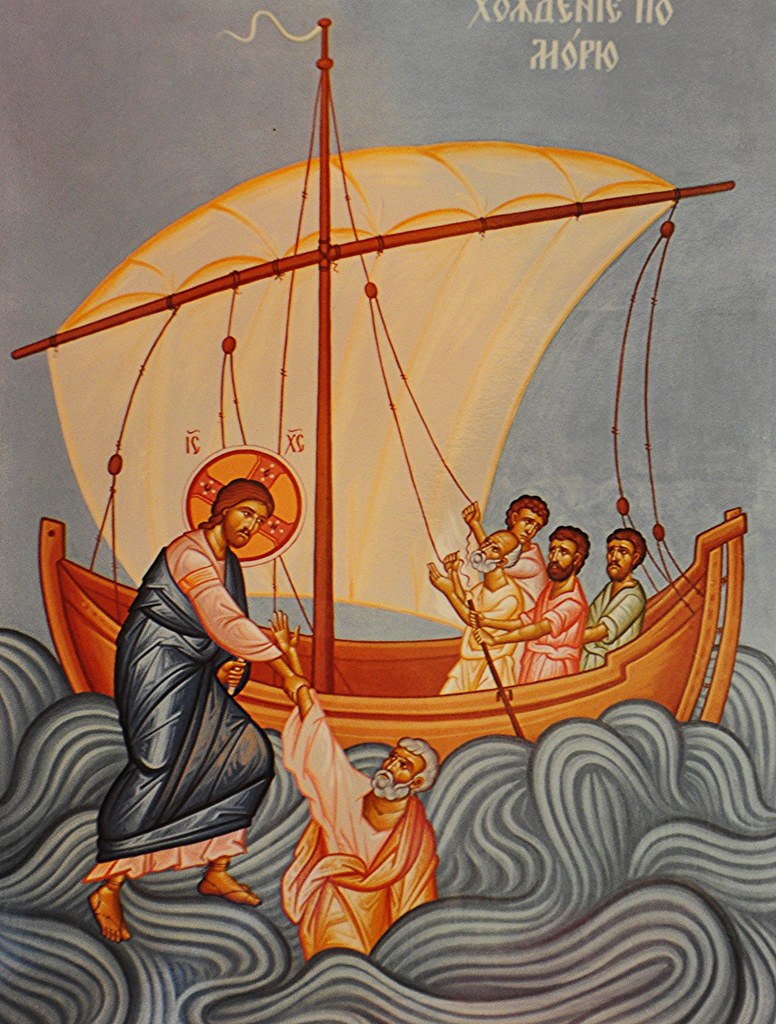
A reflection Matthew 14:22-23, Jesus’ encounter with his disciples on a stormy Galilean Sea.
One way to read this text is as an exhortation to have more faith, to be more trusting. We would be better disciples if we just tried harder. But, I don’t read it that way. I think it is actually a reminder that Jesus–only Jesus–his presence, his power, can still our storms and calm our fears. Jesus, our savior, is the one who guarantees our safety and security; we simply are not able to do that on our own.
“Don’t worry.”
When was the last time someone so helpfully told you, “Don’t worry?”
Was it in the midst of a health scare, when you were trying to get a clear diagnosis? Was it in the middle of a financial crisis, when you were wondering how the month’s bills were going to get paid? Was it when you were sharing your concerns about your children with a friend, alarmed at their dubious life choices?
And, more to the point—did it help? Did having someone say to you, “Don’t worry,” actually help you not to worry? I ask, because, in my experience, someone simply telling me not to worry has not been very effective. “Easy for you to say,” I often think, when hearing those words—you aren’t in my shoes, facing my challenges. “Easy for you to say; much harder for me to do.”
This all came to mind for me as I was reflecting on this Gospel text, because, to be honest, I had somewhat of the same reaction when I heard the words of Jesus, telling his disciples, “Do not be afraid.” Easy for you to say, Jesus; much harder for them—and for us—to do.
In this text, Jesus’ instruction not to fear is not theoretical or hypothetical. Instead, it comes right in the middle of a vivid, fearful situation. In fact, our text starts with fear, and it ends with fear, and, I have to say, I don’t think Jesus is at his most pastoral here.
The disciples are in peril, real peril—a dangerous storm on the Galilean Sea is no joke, and to have spent the entire night battered by the waves, pushed far away from shore is terrifying. Their nerves are frayed, Jesus is nowhere to be found, and when they finally peek out onto the water in the haze of the breaking dawn, they see something, someone, but it isn’t clear whether it is friend or foe. So, sleepless and exhausted, they assume the worst, and cry out in fear. I don’t know about you, but I can relate.
The fact is that challenging external conditions—the stressful, painful situations in which we find ourselves—not only cause us to fear, but they can easily cause us to doubt ourselves, and to despair of God’s love for us, and God’s good care. Don’t you assume that the disciples wondered more than once where Jesus was, in the midst of their anxiety? Haven’t you wondered more than once where God is, in the midst of your suffering?
And to be honest, Jesus simply telling them not to be afraid is not all that helpful. What actually helps, what really works, what finally calms the waves and stills the storm, is Jesus himself showing up and stepping into the boat: not the determination of the disciples to suck up and gut it out; not any words of advice or admonishment, but the power and presence of our Lord and Jesus Christ. They couldn’t drive away the fear on their own; only our Savior could do that.
There is a lesson to be learned here.
What this text shows us so clearly is that being a faithful disciple is not about following orders, obeying rules, doing the right thing. Our own willpower—strength, commitment, determination—whatever words you want to use, is simply not enough, and we fool ourselves if we try to convince ourselves that if we were just better, or stronger, or had more faith, everything would be ok.
I’m not actually surprised that Peter couldn’t walk on water, but I give him credit for trying. And, there is no reason why we can’t try, too, when Jesus calls us to “Come.” But let’s be honest: the waters around us are rarely going to be mirror-smooth, and the winds are rarely going to be still. In spite of our resolve, our feet will slip and our nerve will fail. It is the fallible human condition.
We can do a lot when the conditions are perfect, but those times are rare. In other times, most of the time, when we are fearful and dangers are close at hand, the best thing we can do, the most faithful thing we can do, is join Peter in saying, “Lord, save me!” And, just like Jesus did with Peter, we can be confident that Christ will reach out his hand to us and pull us to safety, to himself.
I wish that I didn’t get so afraid—afraid about the future, afraid about whether I am doing the right thing. I wish that my trust in Jesus was deeper and stronger. But, I give thanks to God that Christ makes up for all I lack, and that my life does not rest on my own abilities or strength, but instead, my life rests in Christ’s strong arms. And, I know that he is stronger than all my fears, and that in his presence, by his grace, I will weather every storm. And you will, too. He promises us that.


