

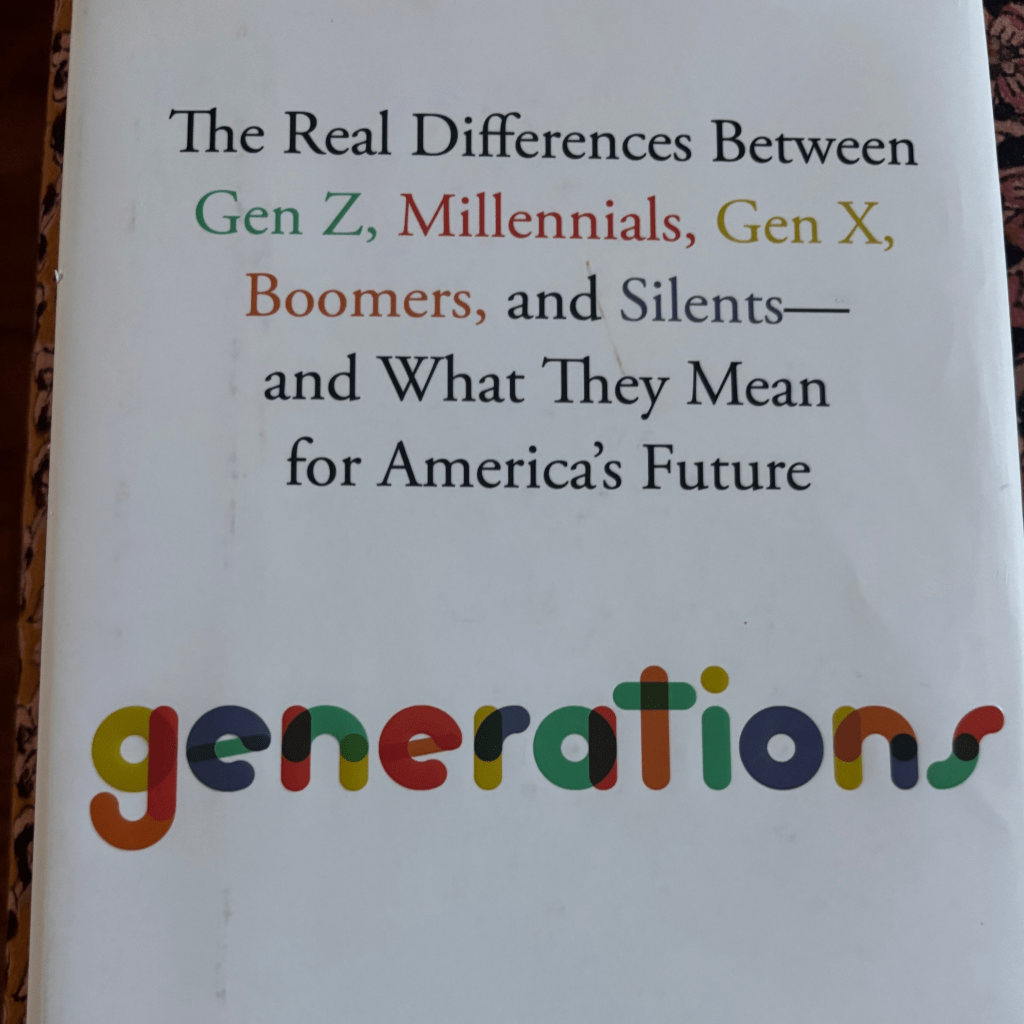
On the recommendation of a friend, I just finished Generations: The Real Differences between Gen Z, Millennials, Gen X, Boomers and Silents, and what they mean for America’s Future, by Jean M. Twenge. The book was really interesting [and extraordinarily well-researched–when you combine all the different surveys she consulted, the book contains data from roughly 39 million people], and, as it sounds, it compares the six living generations in the United States right now. One of her main arguments is that the different generations are not primarily determined by major events, but by advances in technology–from the washing machine to the TV to the iPhone–and the two “daughters” of technological changes, growing individualism and “slow life” patterns [taking longer to mark developmental milestones, like getting a driver’s license, getting married, buying a home, etc.].
I could talk a lot about what I learned [especially about Gen Z], but in this post, I want to focus on the very last chapter, which elaborated on what all of the data from this research on generations suggests to us about the future. And, in particular, the future of religion. Here are a few quotes from the book:
“All signs point toward religion continuing to retreat among Americans. In 2017, for the first time, fewer than half of high school seniors said that religion was important in their lives, and in 2018, for the first time, fewer than 1 out of 4 high school seniors attended religious services at least once a week” [502].
“Young adults have also become progressively less religious in both public ways (attending services, affiliating with a religion) and private ways (praying, believing the Bible is the inspired word of God, believing in God)” [503].
“The decline in religion could also mean a decline in community–there will be one less place for people to gather in person. Many community services, including help for the poor, are run by religious organizations. In the coming years, other organizations will need to fill the gap left by religious communities” [504].
“Humans have an innate desire to believe in something larger than themselves, and to seek meaning in their lives. If religion stops filling this role, something else will step in to fill it….In general, groups based on political beliefs may be taking the place of religious groups. With political beliefs splintering around education, state, and rural versus urban locations, Americans are increasingly surrounded by people with similar political beliefs. Political views become sorted into moral tribes, with each side disliking or even hating the other. For many the world is sorted into us and them, believers and heretics. World history suggests that transferring religious beliefs into politics will not end well [504].
It is really those last two quotes that struck me, because I know that belonging to a religious community supports health and well-being, stronger relationships, and more constructive engagement in the world. [And that is backed up with other survey data as well.] Twenge spends time in every chapter talking about mental health trends within each group, and no one will be surprised to hear that mental health challenges–including depression and social isolation–have really increased with Gen Z. The church can be a wonderful place of inclusion and belonging; how can we best embody that for those who need a place like that the most?
Additionally, Twenge also notes that because of the declining birth rate, which has been accelerating since the Millennials, and because people are living longer, there is an increased possibility that more people will reach old age without family ties–and she points to the current situation in Japan as a place where this is already happening. Again, at its best, the church is a family–a family where everyone is welcome, no one is turned away, and we all are siblings in Christ. I think about the isolation that older people can experience, and how church communities can become family for those who don’t have any living relatives, or any relatives who live close by.
So, what is the future of the church? We know that church attendance is declining; we know that more congregations are closing. Yet, it is so clear that there is still such a critical need for the church in our society. My hope is that congregations, leaders, and all the baptized might recognize both the challenges and the opportunities of this moment, and continue to seek creative ways to welcome and invite others to “come and see”–and then stay and live, together.

 Happy Lutheran
Dear Kristin. Thank you for writing about this. My grandchildren are
LikeLike