

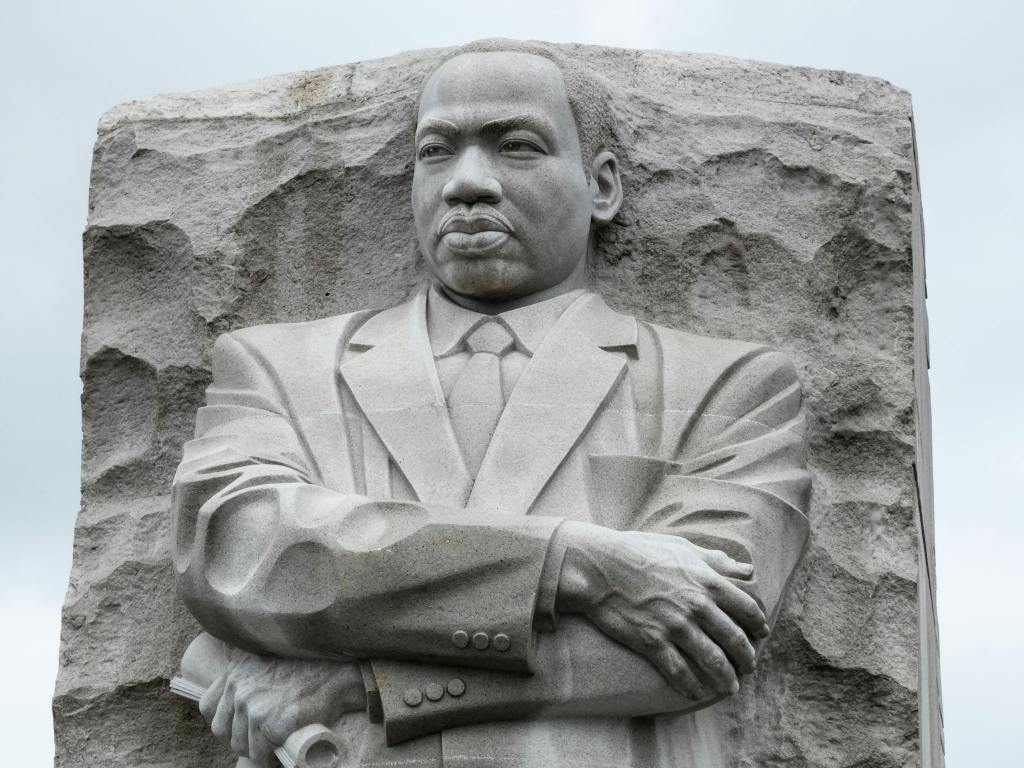
Given that today is Martin Luther King, Jr. Day, perhaps you might have imagined that this post would be titled, “Remembering” MLK–you know, looking back and celebrating who he was and all he accomplished.
But, that is not what I want to do today, January 20th, 2025. Today, I want to invite us to look forward, not back, and be inspired by Dr. King to live a life of meaning and purpose even in the face of challenges, in spite of being discouraged, against all odds–just like he did.
We don’t honor Dr. King best by remembering the past; we honor Dr. King best by emulating him in the present–and embodying the best of his convictions for the sake of the future he dreamed of.
There are lots of people who know much more about his life and work than I do–you might be one them–but, from my own sense of who he was, here are a couple things I am thinking about, as I am imagining what living into his legacy might look like:
1. Keep growing and learning: One of the things that I learned about Martin Luther King Jr. from James Cone is how his views and rhetoric changed when he started visiting Northern cities, and saw the condition of what Cone calls “urban ghettos.” From his experience in the South, he had developed one view of racism, one lens through which he viewed race relations. But, as he spent more time in the North toward the end of his life, he experienced a different way that racism manifested itself, and understood that different language was needed to speak to African Americans in those urban contexts. The point is, King kept himself open to new experiences–learning from new situations, listening to different people, and allowing his views to be changed through those experiences. Keep growing and learning.
2. You don’t have to be perfect: King’s moral failings are well-known, as is his sexism. The latter should not be a surprise, given the time in which he lived, and yet, that is an explanation and not an excuse. So, King wasn’t perfect: neither am I, neither are you. One thing that everyone who has read a bit of the Bible knows is that God regularly and consistently works through imperfect people–people who make bad decisions, people who make mistakes, people who sin. Don’t tell yourself that you are too flawed, too compromised, too whatever to make a difference. If not you, who? Don’t wait for the perfect person to do the necessary work of justice and peace; you are enough. You don’t have to be perfect.
3. Find your foundation, and make it your stronghold: Dr. King’s–Rev. Dr. King’s–faith was the bedrock of everything: his identity, his work, his beliefs, his moral code. He knew, with great certainty, that God was at work in the world for good; that the power of God was working through him and others for peace, reconciliation, hope and justice. Through all of his trials, setbacks and doubts, he was not alone–he was inspired, in the very literal sense of the word, and he know God was with him. He was not afraid of speaking out. He was not afraid of the fight. He was not afraid of dying. He knew who he was, as a beloved child of God, and it carried him in every aspect of his life. Know who–and whose–you are.
4. Speak hard truths–in love: Dr. King is renowned world-wide for his rhetoric: he is without question one of the best orators of the 20th century. What I find so amazing about his language is the way that he managed to always tell the truth–hard truths, painful truths–but in a way that the underlying Christian love and respect he always had for his fellow humans also shines through. His Letter from a Birmingham Jail is one of the best examples of this. Too often, people take the invitation to “speak the truth” as an excuse to be condescending, disrespectful, judgmental and smug. This is not only ineffective, but an easy, feel-good self-righteousness that only deepens divides and widens gaps between opposing sides. Don’t forget about love.
5. Set a big table: This follows directly from the previous point. Instead of assuming people who disagree with you are your enemy, why not assume that they are potential allies, or at least potential conversation partners–or maybe even potential dinner guests. One of the great metaphors for hell [this is well-known] is everyone sitting at a table full of lavish food, starving, because the utensils all have handles that are too long to allow each individual to feed herself. But, this same image becomes heaven as soon as people start feeding each other; then everyone has more than enough. So, perhaps don’t be quite as selective about the guest list at your next party. Crack the door, set an extra place, and if someone unexpected rolls in off the street, take their coat and invite them to sit down. Set a big table.
In his book, Malcom and Martin in America, Cone quotes the following statement from Dr. King:
[Violence] may murder the liar, but it doesn’t murder lie; it doesn’t establish truth…. It is always a descending spiral leading nowhere. This is the ultimate weakness of violence: It multiples evil and violence in the universe. It doesn’t solve any problems.”
I would argue that this is not only true of physical violence, it is also true of rhetorical violence; and we live in a world where there is far too much rhetorical violence–and the real danger looms that it simply will become the norm for everyone, for our whole society.
Before you make that assumption, and before you give in to that temptation, remember Dr. King and a life that stood for something very different; remember his active, vital hope that the world could be different. His vision is a future worth fighting for.

 Happy Lutheran
Happy Lutheran was great about MLK. They had to raise the flag for Trumps inauguration, but they will fly at half mast again. I watched it. It’s history. Trump looked so smug. Didn’t see his pants light up though – liar, liar, pants on fire! Love Mom
>
LikeLike