
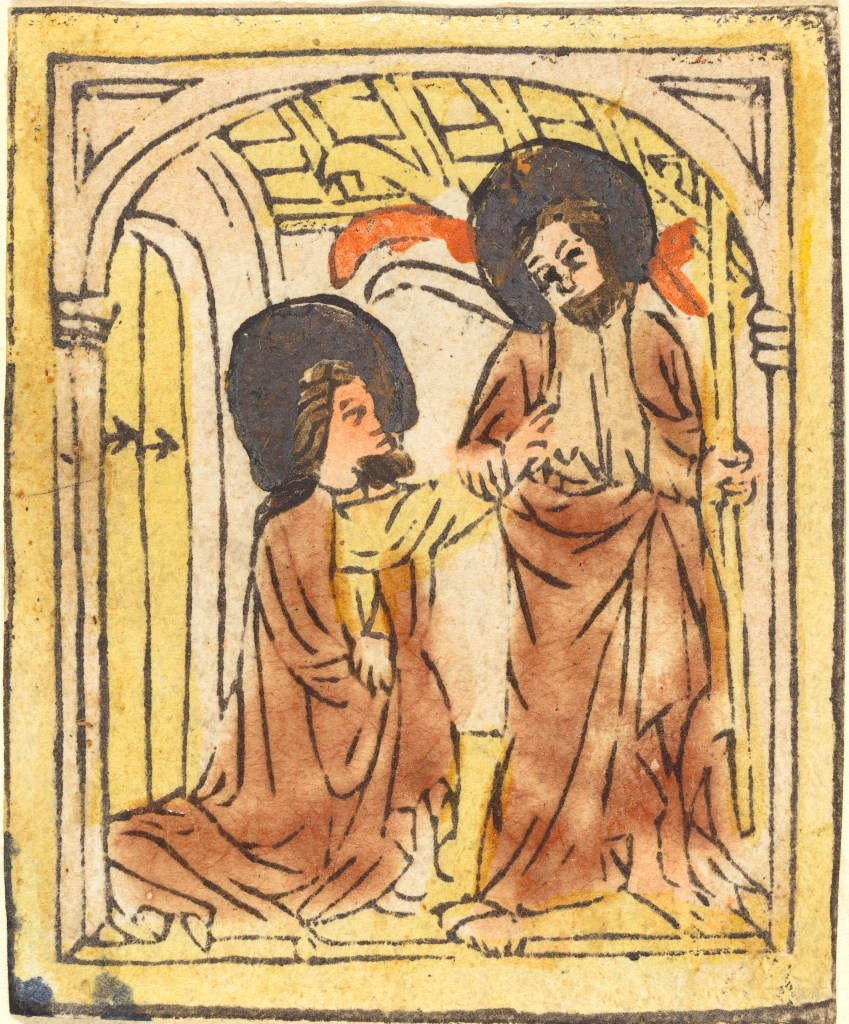
overall (external frame dimensions): 39.4 x 31.8 cm (15 1/2 x 12 1/2 in.), Rosenwald Collection, 1951.10.2″
Yesterday I preached in chapel on the “doubting Thomas” text: you remember the story. Thomas misses Jesus’ appearance to the rest of the disciples, and declares his unwillingness to believe unless he sees and touches Jesus’ resurrected body for himself.
I have always liked this text, because I think it offers so much opportunity to reflect on what it means to believe, what Christian faith looks like, and the role of doubt in our faith. This time, as I was reading the text, I was led to one of my favorite theologians, Paul Tillich.
The sermon is below; I hope it invites your own reflection on the relationship of faith and doubt in the life of a Christian today.
When I was a student at Wartburg Seminary, Bill Weiblen, former seminary president and professor of systematic theology, was one of my mentors. I was fortunate enough to be able to take a class with him on Paul Tillich, who himself was one of Professor Weiblen’s own teachers at Harvard. Those are shoulders on which I am proud to stand.
I was reminded of all of this last week, as I was pondering today’s text, because Paul Tillich had something to say about doubt, and its relationship to faith. And I think his insights are helpful here, because they enable us to move beyond a limited interpretation of doubt that this passage suggests.
Tillich believed that faith, while a gift from the Holy Spirit, was also an act—“an act,” in Tillich’s language, “of a finite being who is grasped by and turned to the infinite.” Faith, then, is a response to the experience of the Holy, and it is the fundamental affirmation of a Christian. For Tillich, faith is an orientation, a commitment—not that this or that belief about Jesus is true, but that Jesus is truth; and that who we are, existentially and fundamentally, can only be understood and experienced in and through this truth, in and through our relationship with Jesus the Christ.
Faith is not one assertion among many; faith is the assertion on which our entire identity is based.
But, because we are human—flawed, frail and forgetful—this affirmation can be harder than it sounds. And so, says Tillich, there is an inherent aspect of uncertainty, an inherent component of doubt in our faith that cannot be removed, but must be accepted.
In this way, doubt is not opposed to faith, nor can faith, even the strongest faith, fully eradicate it. Instead, doubt is faith’s companion in a way, and there is no way to avoid it. Even seeing Jesus with our own eyes, even touching Jesus with our own hands, doesn’t make the doubt go away. Our doubt, then, is different from what Thomas experienced.
Doubt, for Thomas, is related to one very specific experience: the fear of missing out. The other disciples have seen the Lord, but Thomas was late to the party, and he is not about to take someone else’s word for something so monumental. “Unless I can touch him, I won’t believe. I need proof.” For Thomas, it is either faith or doubt—not both.
Now, maybe it is OK for Thomas that, in order to believe he needs to put his hands on Jesus’s resurrected body, but the risen Jesus knows full well that the divine clock is ticking.
Time is running out for the disciples to be able to just pull Jesus out of a hat in order to confirm their telling of this miraculous story. The days when people will be able to see Jesus in the resurrected flesh are soon coming to an end, and the disciples need to get it together and be prepared to tell the story in his absence and share their faith with passion and purpose.
Because the fact is, down through the ages, the strength of the testimony of the gospel of Jesus Christ is not going to be repeated sightings—let alone touchings—of Jesus’ resurrected body. It is going to be the witness of the disciples: their witness and ours.
I think this is why New Testament scholar Rudolf Bultmann said that Jesus was raised into the faith of his disciples. Whatever else it is, the resurrection is the rise of Easter faith. It was the power of this faith that spread the gospel around the globe, not proof of Jesus’ resurrected body, or slivers of the true cross, or the disciples’ body parts, either—regardless of how much as the church capitalized on people’s desire for holy relics. It is their witness and ours, through the power of the Holy Spirit of course, that the spread of the gospel has depended on in the two thousand years since that first Easter morning.
Doubt, then, has a very different role to play when this is the situation. Our doubt today stems less from the question, “Is it true that Jesus rose from the dead,” but more, “is the Truth on whom I have staked my entire existence real?” And so we find ourselves back to Tillich.
We all have our “Thomas moments,” when we long for incontrovertible evidence that what we believe about Jesus is true, but this side of the veil, we will not see what he saw. Our doubt cannot be dispelled in such a straightforward manner.
So, instead, we come to the table, we come to the font, and we come to the Word, where Jesus promises to meet us and strengthen our faith, in spite of our doubt or because of our doubt. Through the Word and Sacraments, the Holy Spirit even uses our doubt to grow our faith. As Frederick Buechner writes, “doubt is the ants in the pants of faith. They keep it awake and moving.”
Let me end this sermon where I began, with Tillich. Tillich was an existentialist, and the existentialist question is, “Who am I, really?” The world repeatedly forces this question upon us, causing us to doubt who we are, and the Christian ground on which we stand. And so, says Tillich, there is an inherent aspect of uncertainty, an inherent component of doubt in our faith that cannot be removed, but must be accepted.
And this acceptance, he famously says, takes courage; Holy Spirit-inspired courage, to be exact. The courage to trust that I really am God’s beloved. The courage to believe that the gospel of Jesus Christ has upended the world. The courage faith requires to tell the story of Jesus Christ in all its foolishness, to a world that rejects it again and again. The courage to be who God has called me to be: a disciple, a believer, a witness, doubt and all.

 Happy Lutheran