
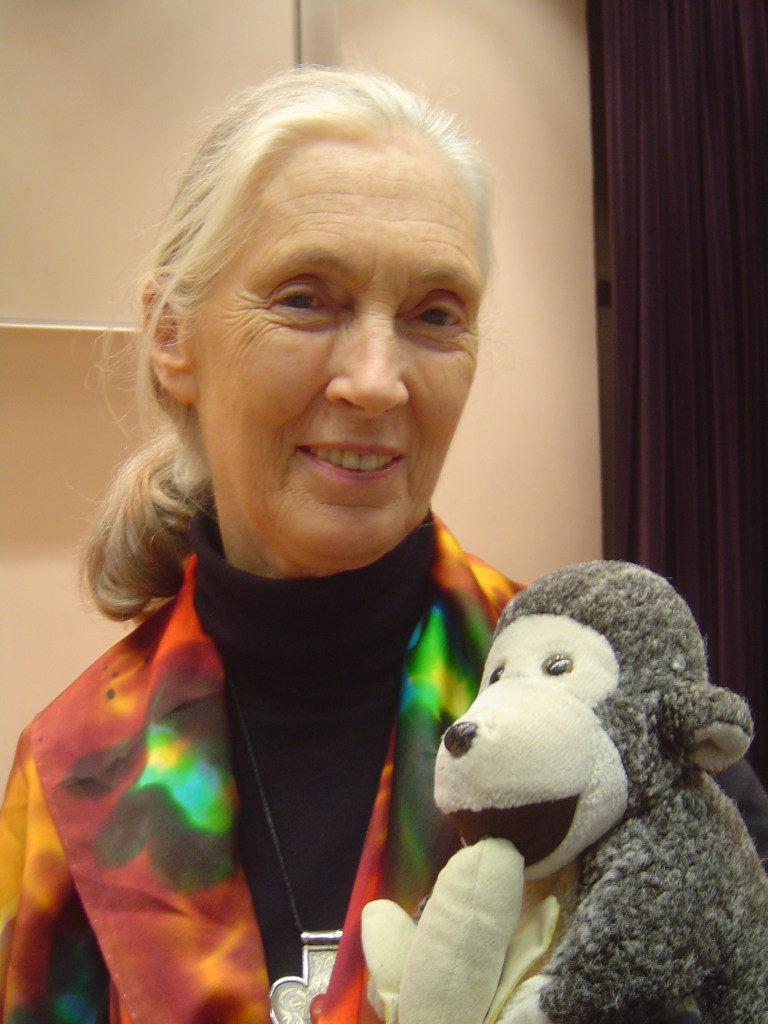
Today, on the feast day of Saint Francis, when churches around the country and around the world celebrate God’s love for the entire cosmos, and especially the animal kingdom, it seems like a good day to commemorate Jane Goodall, who died at the age of 91 on Wednesday.
I encourage you to read more about her online–there is no shortage of articles lauding her life and her significant achievements. Here are just a few notes from her obituary in The New York Times:
On the scientific merits alone, her discoveries about how wild chimpanzees raised their young, established leadership, socialized and communicated broke new ground and attracted immense attention and respect among researchers. Stephen Jay Gould, the evolutionary biologist and science historian, said her work with chimpanzees “represents one of the Western world’s great scientific achievements.”
On learning of Dr. Goodall’s documented evidence that humans were not the only creatures capable of making and using tools, Louis Leakey, the paleoanthropologist and Dr. Goodall’s mentor, famously remarked, “Now we must redefine ‘tool,’ redefine ‘man,’ or accept chimpanzees as humans.”
For me, I see Dr. Goodall as such an extraordinary person in no small part because of how she saw chimpanzees, and by extension other animals, too, as inherently precious and relatable to us as a “thou” not an “it.” This was at a time when animals were viewed by so many as little more than objects–valuable only insofar as what they could provide to humans–or at the very least, with only rudimentary emotional and social lives. [This is evidenced in the fact that Goodall named the animals she observed, rather than simply referring to them with numbers.] Dr. Goodall spent decades observing and engaging respectfully with chimpanzees, discovering things about them that no one at the time could have possibly imagined. She learned about their complex social relationships, their sophisticated behaviors, and their rich, emotional lives. What she discovered invites–compels, really–all of us to think differently about our closest animal relatives–and by extension, all animals.
What else don’t we know, about sharks, tortoises, owls and tigers? What other revelatory knowledge is just waiting on someone willing to put in the time and effort to watch and listen with an open mind to our animal neighbors?
Her NYT obituary also notes that,
In the 1970s, Dr. Goodall began to spend less time observing chimpanzees and far more time seeking to protect them and their disappearing habitat. She made known her opposition to capturing wild chimpanzees for display in zoos or for medical research. And she traveled the world, drawing large audiences with a message of hope and confidence that the world would recognize the importance of preserving its natural resources.
The Commemoration of St. Francis is a welcome opportunity to take a page out of Jane Goodall’s book and pay a little more attention to all the animals with whom we share our lives–both in our homes and outside them, both near and far–and to advocate for their care and protection, and for the care and protection of their homes.
For Christians, this is an important aspect of our Christian discipleship: to love the world that God loves; to love our animal neighbors God has created good.

 Happy Lutheran