

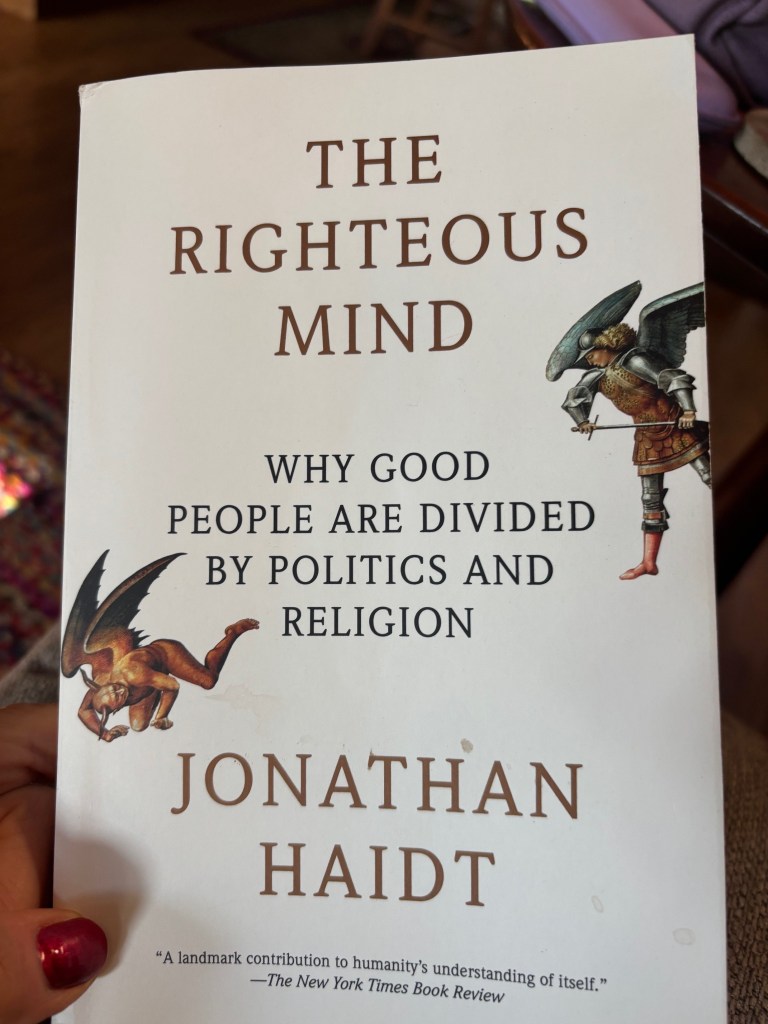
On the recommendation of a friend and colleague, I just finished a very interesting book, The Righteous Mind: Why Good People are Divided by Politics and Religion, by Jonathan Haidt. It is dense and well researched–and quite compelling. I started taking notes for this blog post and I quickly gave up–no one wants to read a 5,000 word book review! So, I am going to just hit the highlights and give a general sense of the argument, but the upshot is that I really do recommend it.
The thesis of the book as follows: “This book is about why it’s so hard for us to get along. We are indeed all stuck here for a while, so let’s at least do what we can to understand why we are so easily divided into hostile groups, each one certain of its righteousness” (xviii).
The book is organized into three parts, and each one comes with a metaphor. The main argument of the first part is: Intuitions come First, Strategic Reasoning Second. The metaphor for this section is that “the mind is divided, like a rider on an elephant, and the rider’s job is to serve the elephant.” The elephant is our intuition, our emotions, and it is the elephant that runs the show; we use our reason (the rider) to support what we already feel and think to be the case. In other words, moral judgment isn’t exclusively–or even primarily–a rational affair; overwhelmingly, our moral judgment involves how we feel, and our subconscious reactions to the world. Haidt notes the work of one researcher who observed, “conscious reasoning is carried out largely for the purpose of persuasion, rather than discovery” (89). [If you know anything about confirmation bias, you will know this to be true.] Another way Haidt says this is, “moral thinking is more like a politician searching for votes than a scientist searching for truth” (106). This means that we should be wary of the idea that “reason” is objective, and that rational arguments are the best way to change someone’s mind. Haidt writes, “Reasoning can take us to almost any conclusion we want to reach, because we ask ‘Can I believe it?’ when we want to believe something, but ‘Must I believe it?’ when we don’t want to believe.” The answer is almost always yest to the first question and no to the second” (107).
The main argument of the second part is: There’s More to Morality than Harm and Fairness. The central metaphor here is “the righteous mind is like a tongue with six taste receptors.” The point of that metaphor is that there are actually different moral frameworks, and different ways of thinking about the concept of morality–and that the more frameworks one can draw upon, the more appealing the argument can be.
He identifies six different “moral foundations” that can be employed to make moral judgments:
Care/Harm—focuses on compassion, and caring for those who are suffering
Fairness/Cheating—focuses on fairness (specifically proportionality), justice, and trustworthiness
Loyalty/Betrayal—focuses on group pride, loyalty, patriotism and self-sacrifice
Authority/Subversion—focuses on respect, and emphasizes obedience
Sanctity/Degradation—pays attention to feelings of disgust, and emphasizes purity, cleanliness and chastity
Liberty/Oppression—pays attention to attempted domination, and triggers an urge to resist bullies and tyrants
What is particularly interesting about this section are the differences he notes between Democrats and Republicans [liberals and conservatives]. Haidt argues that “Liberals have a three-foundation morality, whereas conservatives use all six. Liberal moral matrices rest on the Care/harm, Liberty/oppression, and Fairness/cheating foundations, although liberals are often willing to trade away fairness (as proportionality) when it conflicts with compassion or with their desire to fight oppression. Conservative morality rests on all six foundations, although conservatives are more willing than liberals to sacrifice Care and let some people get hurt in order to achieve their many other moral objectives” (214). That whole argument is fascinating, and explains why Democrats often have a harder time appealing to a wider range of voters; they too often rely on a much narrower moral framework. [Seriously, if you are interested in politics, you must read this part of the book!]
The third part is the one the most directly relates to religion. The title of that part is: Morality Binds and Blinds, and the central metaphor of this part is “We are 90% chimp and 10% bee.” That is, we are both selfish and groupish–“We are not saints, but we are sometimes good team players” (221). We are Homo duplex, and we exist simultaneously as individuals and as part of a group. (And, depending on how you are wired, how you were raised, and the larger society in which you live, one or the other identity might dominate your moral framework.)
But, for all of us, there is a hive switch that can flip inside us and move us from thinking primarily individualistically to experiencing ourselves first and foremost as part of a greater whole. Haidt gives the example of attending a UVA football game, the experience of awe in nature, or repeated drills in the military. And, he argues that these “hive experiences” are where we find our greatest joy–“Happiness,” Haidt argues, “comes from between” (283). We evolved to live in groups, and being a part of a group makes us happier and more fulfilled. [He cites the work of Robert Putnam to support this conclusion as well: “the social capital that is generated by such local groups ‘makes us smarter, healthier, safer richer and better able to govern a just and stable democracy” (282)]. Religions function this way, too: they create an identity through belonging, believing and doing together.
I could say so much more about the book, but I really encourage you read it for yourself. Haidt emphasizes that “Moral communities are fragile things, hard to build and easy to destroy” (342): we need each other–and, frankly, that the liberal and conservative moral frameworks both need each other, too. Haidt argues that the blind spot of the left is that it doesn’t consider the effects of changes on moral capital–and often overreaches and moves too quickly, and the blind spot of the right is that it doesn’t notice certain classes of victims, fails to limit the predations of certain powerful interests, and fails to see the need to change institutions (342-343). All societies need a balance, and because of the contentious nature of the current social and political climate, we no longer talk together, befriend each other, or try to learn from each other.
Here’s how he concludes the book: “So the next time you find yourself seated beside someone from another [moral] matrix, give it a try. Don’t just jump right in. Don’t bring up morality until you’ve found a few point of commonality or in some other way established a bit of trust. And when you do bring up issues of morality, try to start with some praise, or with a sincere expression of interest. We’re all stuck here for a while, so let’s try to work it out” (371).
Exactly.

 Happy Lutheran