
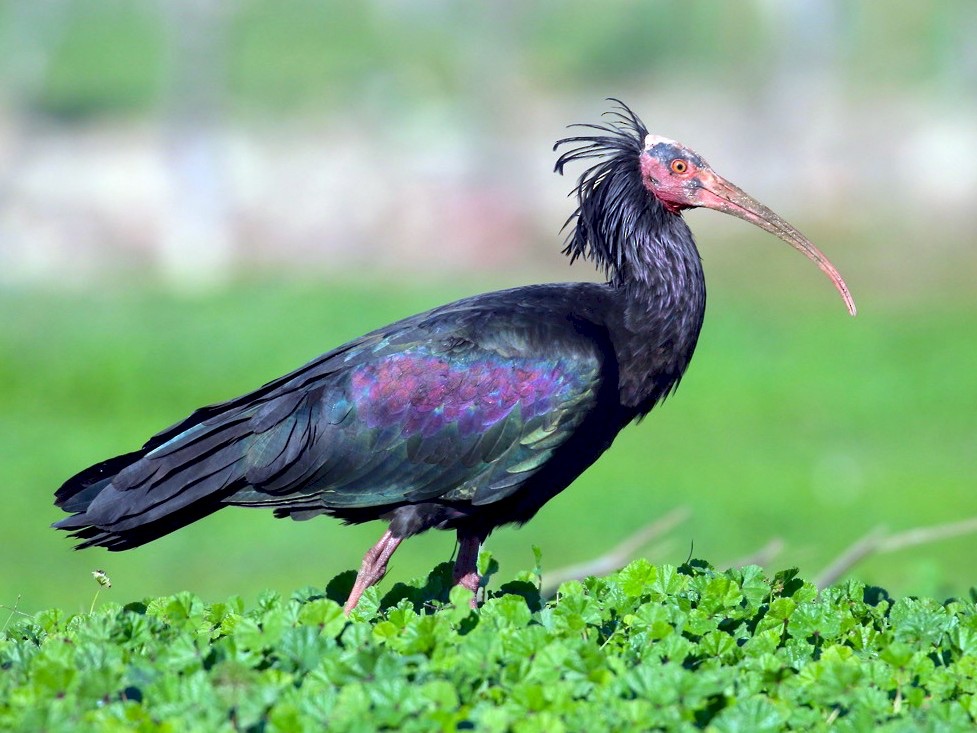
I wanted to share some reflections from an article in the recent issue of The New Yorker. The title of the article was “Helicopter Parents” (by Nick Paumgarten), and from the title alone, I imagine the same topic jumped into your mind as it did into mine: those human parents who hover over their children, trying to protect and control all aspects of their lives. However, that is not at all what this article was about; instead, the subtitle gave it away: “The daring attempts to teach an endangered ibis species to migrate.”
The whole article was almost unbelievable. It told the story of a team of volunteers who use a microlight aircraft to coax a population of endangered northern bald ibises to migrate, and attempting to save them from extinction outside of European zoos.
For the last 20 years, the pilot of the aircraft, Johannes Fritz, has led a flock of young ibises on a harrowing, weeks-long fall migration from Germany to their wintering grounds on the southern coast of Spain. The hope is that these birds will be re-introduced into the wild, and be able to reproduce and thrive.
You can find more about this project here: https://www.waldrappteam.at/en/projects/
The whole thing was almost impossible to believe, and quite amazing, in a tragic sort of way.
Here’s the paragraph in the article that I keep coming back to:
Our devastation of nature is so deep and vast that to reverse its effects, on any front, often entails efforts that are so painstaking and quixotic as to border on the ridiculous. Condor or cod, grassland or glacier: we do what we can, but the holes in the dyke outnumber the available thumbs. Fritz’s microlight brings to mind Noah’s ark, except that it has room for only one niche victim of our age of extinction. The commitment, ingenuity, and sacrifice required to try to save just this one species demonstrate how dire the situation has become, and yet the undertaking also reflects a stubborn hope that’s every bit as human as the tendency to destroy. Fervor in the face of futility: what other choice do we have? That’s the idea behind Fritz‘s northern-bald-ibis project, anyway. This is what it takes, so let’s get to it.
Humans. This is who we are, after all. A species with incredible creativity, determination, selfless devotion, and compassion. And, at the same time, a shockingly self-centered, destructive species that callously bulldozes over other beings that stand in our way.
Not one, not the other, but both—always. We are quite maddening that way.
The age that we live in, the Sixth Great Extinction, is a tragedy of our own making; it is impossible to argue the point. Even as we see the spectacular crash that is coming, we continue to careen down the road, going miles over the speed limit, leaving wreckage and roadkill in our wake.
And yet.
Because we care—and we do care (some of us more than others, of course), there is more to the story than that. There are also the amazing re-wilding projects in Europe, the breeding programs supported by zoos around the world, and the persistent, patient work of the World Wildlife Fund and countless other organizations and individuals who see the inherent value in frogs and coral, tigers and bumblebees—and devote themselves to their protection. Whether it will be enough is, at this point, unknown.
What I take from this ridiculous story of audacious daring is that if you have the chance to save something you love (or even to participate in a painstaking and quixotic effort to save something small)—a little corner of a local environment, a species you rub elbows with—do it. Let your imagination be captured. Allow your efforts to be ignited.
All of this reminded me of a poem, “Let Them Not Say,” Jane Hirshfield.
Let them not say: we did not see it.
We saw.
Let them not say: we did not hear it.
We heard.
Let them not say: they did not taste it.
We ate, we trembled.
Let them not say: it was not spoken, not written.
We spoke, we witnessed with voices and hands.
Let them not say: they did nothing.
We did not-enough.
Let them say, as they must say something:
A kerosene beauty.
It burned.
Let them say we warmed ourselves by it,
read by its light, praised,
and it burned.
We have seen, we have heard—we have actively participated in the earth’s destruction. Let us also actively participate in its saving; whether it is enough or not.
We are humans; “fervor in the face of futility: what other choice do we have?”

 Happy Lutheran