
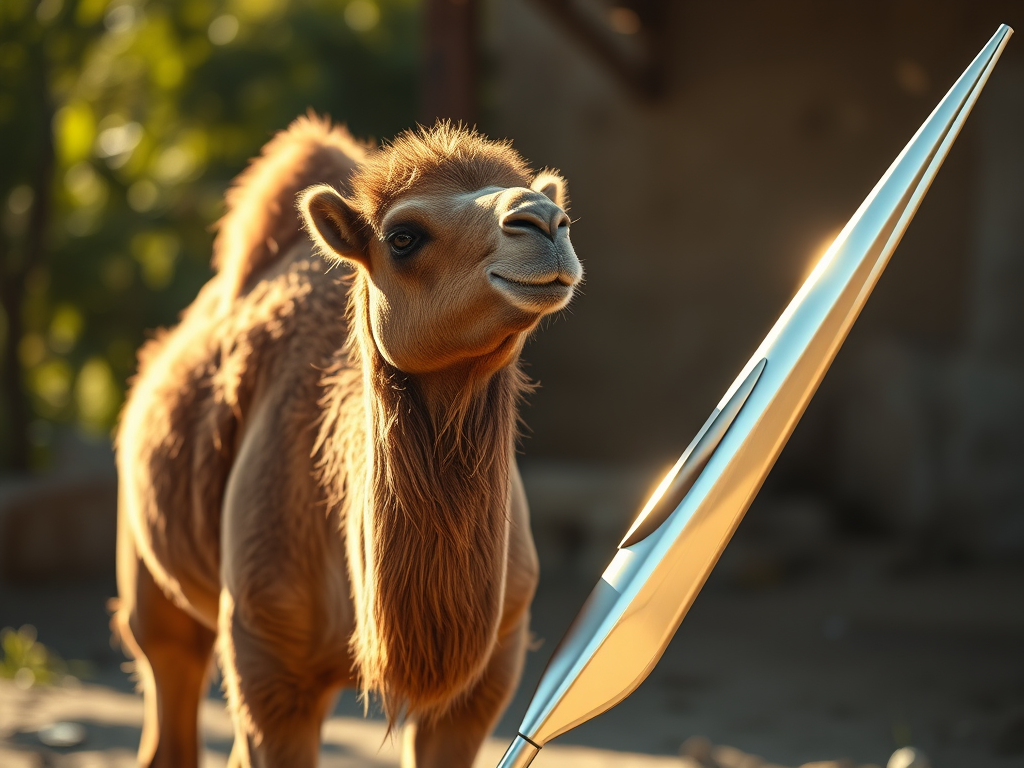
“Then Jesus said to his disciples, ‘Truly I tell you, it will be hard for a rich person to enter the kingdom of heaven. Again I tell you, it is easier for a camel to go through the eye of a needle than for someone who is rich to enter the kingdom of God.’ When the disciples heard this, they were greatly astounded and said, ‘Then who can be saved?’ But Jesus looked at them and said, ‘For mortals it is impossible, but for God all things are possible.’” Matthew 19:23-26
Craig Nessan, one of our faculty members, preached on this text on Monday, and I have been thinking about it every since.
Even if many people don’t know the source or the context, the image of a camel and a needle has entered into common cultural parlance as an example of the ridiculous, the futile, the improbable. The image is absurd, the contrast is extreme, but for those of us who know the point Jesus is trying to making, the image is most serious: we are in an impossible situation, and only God can get us through it.
There were several things that I really appreciated about the sermon. The first one was his address to the congregation: “fellow camels,” he called us. It is a reminder that we humans are alike in our “camel-ness”—we are all in the same situation, tempted by the same siren song that promise contentment through consumption.
Related to this, then, I also appreciated his focus on “the chase” as the problem. Remember, this image comes in response to the conversation Jesus has with the young rich man, who turns away sorrowfully from Jesus, unable to imagine the shedding of his possessions. Who would he be without them? After all, the story doesn’t even give his name, he is simply and completely defined by his wealth: he is “the rich man.”
So, one might assume that it is the possessions themselves that are the problem, but really, the problem is the desire to amass them, hold them, keep them. As Craig said, it’s the chase that turns our attention from Jesus, from our neighbor, from our own health and well-being, narrowing our awareness with an all-consuming focus on acquisition. The chase is exhausting, envy-producing, and never-ending.
So, there is a need to shed baggage, surely; baggage we are constantly, continually tempted to pick up and hoard away. But even more, there is the need to close the browsing windows, put the shopping cart back in the queue, stop giving our neighbors the side-eye, abandon the balance ledger, and stand still, close our eyes, breathe, pray, and hear the word “enough” that the Holy Spirit whispers in our ear. You, beloved camel, are enough, just as you are.
Craig concluded his sermon with these words from “Through the Eye of the Needle,” by Stephen Mitchell.
Lying back on the unbelievably lush grass, he remembers: all those years (how excruciating they were!) of fasting and one-pointed concentration, until finally he was thin enough: thaumaturgically thin, thread-thin, almost unrecognizable in his camelness: until the moment in front of the unblinking eye, when he put his front hooves together.
Took one long last breath.
Aimed.
Dived.
The exception may prove the rule, but what proves the exception?
“It is not that such things are possible,” the camel thinks, smiling.
“But such things are possible for me.”
In this poem, the image is both intensified and it breaks down, and we are forced to hold it paradoxically: the “is” in tension with the “is not.” So, while I really love the image of the camel taking a great chance, hooves pressed together [as though in prayer] and daring to make the dive, I think the image of being “thin” enough is not actually helpful, for two reasons. One, no one who is struggling with their weight and/or body image needs to hear a theological call to get “thinner.” And second, we camels don’t make it through the needle with our own efforts, no matter how excruciating. Regardless of how hard we try, we cannot change our camel-shape, and “thread thin” is beyond our attainment. “For mortals, it is impossible.” Instead, it is God who carries us through.
As even the camel himself notes, it is the for me that is the miracle in this story, the possibility of a new life, a new way of valuing myself and others, a new sense of identity and wholeness found in Jesus Christ. In my read of this story, the “Kingdom of Heaven” isn’t pointing to salvation after death, but rather the experience of the inbreaking of the kingdom of God here and now. Life on the other side of the needle’s eye is a life of abundance, trusting that God will provide more than enough for all, and knowing that I do not have to fight my fellow camels for lush grass and take more than I need, just in case.
Ultimately, the parable of the camel and the needle is a story about the heaven-on-earth that God invites us to see and experience here and now–impossible for us to imagine without the transformation God works in us and our fellow camels. But once we have experienced it, we can never go back. It’s a one-way eye, and a miraculous, life-changing leap that God makes possible–for all of us.

 Happy Lutheran
This is simply fantastic. Thank you dear Kristin. Mrs Ryan 😘🙏🎈Sent from my iPhone
LikeLiked by 1 person