

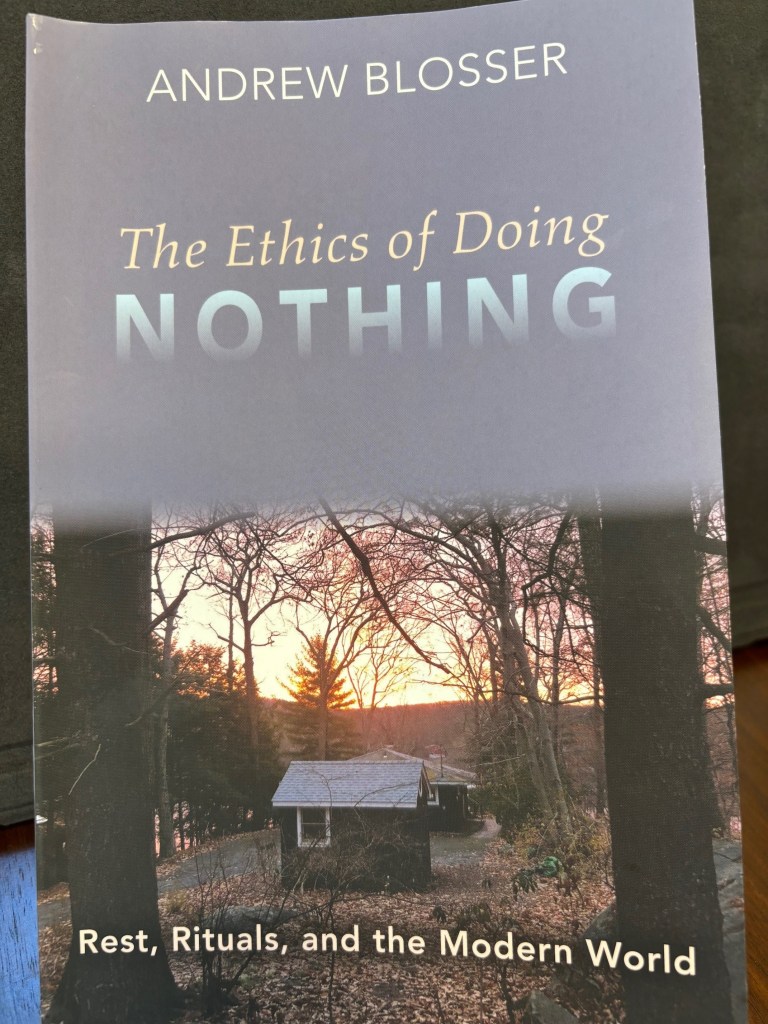
One of the best parts about attending the American Academy of Religion Conference is the chance to wander through the book displays. I picked up a couple new books, and read this one on the plane ride home. It was interesting, and I wanted to share a few thoughts from it.
The thesis of the book is to offer an “ethics of inoperativity,” in particular for our United States society that is “obsessed with working and is beginning to suffer the consequences” [14]. The basic idea is that “the modern world consists of a summons to do–to make, invent, restore, and alter” [1]. On the one hand, there is nothing wrong with “doing,” but when doing/achieving/acting/working become synonymous with what it means to be human [“the modern paradigm has identified human nature with work” (8)], then we have a problem. We have problem with our own identity, we have a problem with our relationships–to one another and to God–and we have a problem in the environment, which bears the brunt of human “production.”
So, if the idea is that “life transcends productive work” [108], he argues his case by describing how religious rituals reinforce this counter-cultural truth, how they are “ethical tools for learning how to embrace inoperativity” [12].
To this end, Chapter Two is a great chapter, using the work of Jűrgen Moltmann and Abraham Joshua Heschel to describe the ritual of Sabbath-keeping in Jewish and Christian traditions. I love Heschel’s description of the Sabbath as a “‘temple in time’ that God and humans inhabit together” [62].
Blosser begins the first chapter with this interesting quote: Prayer and ethics are simply the inside and outside of the same thing, John A. T. Robinson [17]. This quote summarizes well the argument he is making, which is somewhat paradoxical. On the one hand, he emphases that rituals don’t “do” anything, in the sense of how we usually think of that word, related to production. They are, in and of themselves, the point–they do not “accomplish” anything. They are, instead, examples of intellectus, rather than ratio–the former being the kind of knowing that is receptive, rather than the latter kind of knowing whereby someone “takes hold of [the world], controls it, and makes it fit the categories of the mind” [30]. So, when we are engaged in intellectus, we are observers, listeners–attentive to the One and the ones around us in the experience of being “enveloped” in a transcendent I-Thou experience [my words].
However, on the other hand, rituals, including worship, do have an affect in one’s life, in the life of a community, of a society; to go back to the quote I mentioned, they have an outward expression that flows from this experience of receptive knowing. Sometimes this connection [between prayer and ethics] is hard to recognize when it is there; however, here is the unsettling example he gives that makes it very clear when the connection is absent.
It is a warm Friday evening in Rwanda in April 1994. As crickets chirp, and the last rays of sunlight glimmer over the horizon, Seventh-day Adventist workers prepare to rest. They wash their tools, placing them in the corner of their houses, ready to grab them for work on Sunday. Like most Jews, members of the Seventh-day Adventist denomination keep Sabbath from sundown to sundown, beginning on Friday. Following Jewish antecedents, within Adventist culture there is a rich tradition of “welcoming the Sabbath” by cleaning one’s house and other appliances, as if an honored guest were about to arrive. These Sabbath keepers want to put distractions out of their mind so that they can spend the day in peaceful relaxation, worshiping and praising God. They want a momentary respite from thinking about the tools they have been using all week in vigorous manual labor.
What are these tools they are washing, tools they will pick up after Sabbath hours are over? Machetes. Why are these tools dirty? They are coated with human blood.
This is not a fictional scenario. Adventist political scientist Ronald Osborn reports that Rwanda’s population at the time of the genocide was about 10% Seventh-day Adventist. A subset of these Adventists were Hutus–members of the ethnic group from which a faction emerged that perpetrated the killings of their Tutsi neighbors. Although many Adventists attempted to save their fellow Rwandans, Osborn spoke with a church official in Rwanda who said that “some Adventists maintained their Adventism by scrupulously, resting from killing on the Sabbath.” [73-74]
This is an extreme example, but history [and our contemporary context] is littered with examples of people who enter a church, a mosque, a synagogue or a temple, leaving cares/ideologies/actions/even metaphorical machetes at the door, only to pick them right back up, unchanged as they walk out. Blosser says, “For many practitioners, rituals represent states of being that are unconnected to life as a whole. One prayes or rests, and then proceeds with ‘life as usual'” [74].
So, here is the key paradox: “doing nothing must do something” [75]. Worship is not a means to another end, and yet, it should show forth its transformative power, the power of “ritual inoperativity,” the power of intellectus in the larger life of the practitioner, and the community. In other words, Sabbath-keeping, resting, is radically counter-cultural, and makes a powerful statement about what it means to be truly human, created in the image of God and for communion with God, humanity and creation.
Thus, he argues, “Embracing ritual inoperativity means that one cannot set down one’s tools before Sabbath begins and pick them up after the day is over without questioning how those tools are used and what system they reinforce” [104]. Rituals are both inherently valuable in and of themselves AND have effects and purposes outside of themselves.
Another piece of his argument here is the work of Roberto Goizueta, and the role of fiestas, vigils and other rituals in the Latinx context. In the rituals of Latinx popular religion, “activities are intended to draw the participant into a physical, tangible relationship to God and community, and thus construct an intrinsically good conretre way of being in the world” [99]. They provide “intentional community construction” [100].
So, if your life is “worship-centered,” what does that really mean? How does that look in your life, in the life of your community? I continue to think about those questions.
I want to end this post where Blosser ends the book–with hope. He writes:
…the most vital ethical element in rituals should be hope. Faced with the cataclysmic potential of climate change and the grinding, soul-crushing force of work-related status anxiety, it may be tempting to write off rituals as mindless rigmarole…Nevertheless, if we undersatnd rituals as a form of life–an end in itself that also forecasts our ultimate state as human beings–they can foster genuine conviction that a better world is possible…..Although this world appears foreign and distant in our present context, the legacy of vigils, fiestas, and Sabbaths tell us that it is far closer than we think [182-83].

 Happy Lutheran