

Recently, I was down in San Antonio for the annual board meeting of the Hispanic Summer Program, which is a fantastic program that will celebrate its 35th anniversary next year. Wartburg Seminary is a proud supporter of this program.
This is HSP mission statement [and you can find more about it here: https://hispanicsummerprogram.org/about/]
Founded in 1989, the Hispanic Summer Program seeks to shape the next generation of Latinx theological and academic leaders. Through our distinct programming, we work to shift the discourse on Latinidad in theology, in higher education, and within the active ministries and communities led by our alumni and touched by our faculty. We do this by raising up a uniquely Latinx perspective, lifting up the often unheeded views of the Latinx community, and centering the conversation with distinctly Latinx voices.
As part of that meeting, we always do some educational experience that allows us to engage in deep reflection on social, cultural and religious issues that impact theological education.
This time, we visited two of the historic missions in San Antonio, Mission Concepción and Mission San Jose. We had a tour at both of the sites, and what we experienced prompted thoughtful reflection on memory and identity, and how institutions tell their stories and preserve [or don’t preserve] different facets of their history.
At Mission San Jose, we learned that the Franciscans set up these Missions and welcomed the indigenous people to live within the walls of the compounds as a way to protect them from other Europeans [and the diseases they brought with them], and other Native American groups.
And, in fact, if you look at the National Park Service’s webpage on the Missions, this is what you read at the top of the page:
After 10,000 years, the people of South Texas were faced with drought, European diseases, and colonization. In the early 1700s, many Native people of South Texas foreswore their traditional life to become Spanish, accepting a new religion and agrarian lifestyle in hopes of survival.
That is hardly the full picture, is it?
Because, the fact is, the cost of this transition was that the people had to become Spanish citizens: they had to speak Spanish, they had to convert to Christianity, and they had to adopt Spanish customs and beliefs. In other words, cultural erasure. In order to be safe, in order to survive, they had to give up their own core identies, the identies of their ancestors dating back for thousands and thousands of years.
While there, I learned that there are active, living descendants of these indigenous peoples who are still in the area, and who are able to reflect on what this history [and the Missions themselves] means to them. [And, from my view, it seems like there has been an attempt more recently to include more of these voices in the standard tours and signage.] Our guide at Mission Concepción was himself one of these descendants, and he was both very proud of that fact and an extremely devout Catholic [at least, that is how he presented himself in the way he described the church].
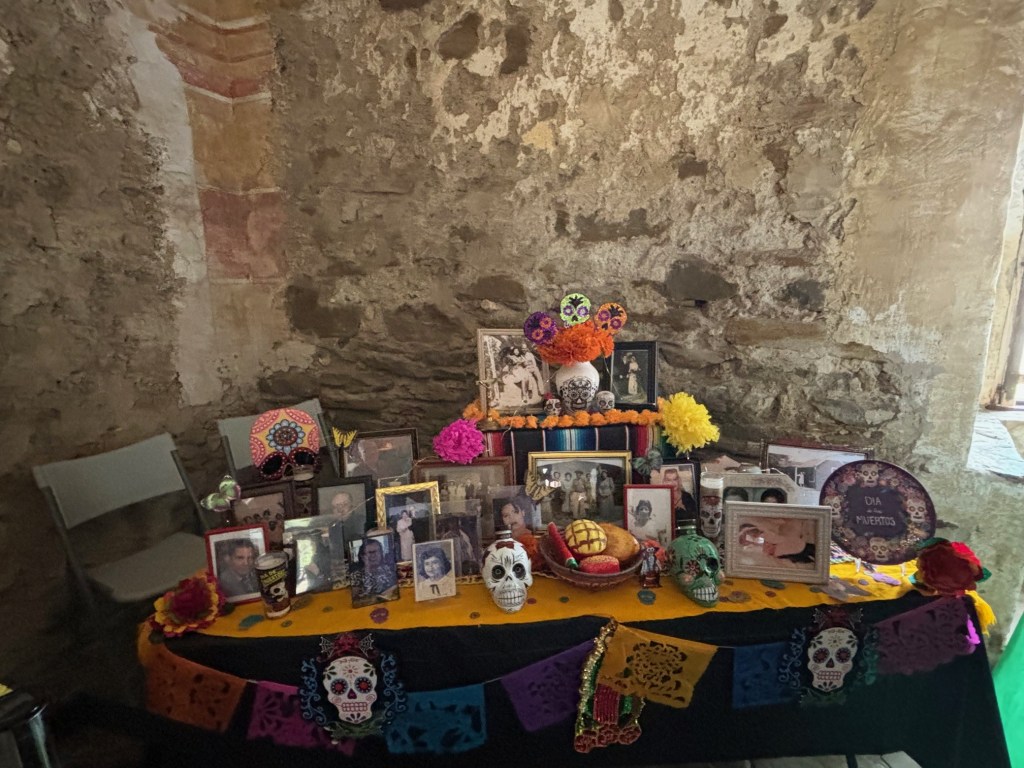
Because our visit took place just a few days before the Day of the Dead, there were ofrendas at both Missions, too, which had been set up by many of these families. These are such beautiful sites of memory and identity. Here is one of them:
Finally, there was also a film that we watched, which brought all of this history to lief. So, what to make of all this?
Together, board members reflected on our visit the following morning, and it was very interesting to hear what people experienced, and what thoughts were prompted. I share some of those thoughts under three categories.
MEMORY: What do institutions choose to remember, and what do they choose to forget?
We talked a lot about names: what names are remembered and recorded, and what names are simply forgotten. At one of the Missions, our guide mentioned that there were over 200 different Native American groups that lived there and related to the Missions, and then she said something off the cuff like, it’s too many names to remember and you probably aren’t interested in all of them anyway. That was a deliberate choice of erasure.
IDENTITY: What identities do some people have to sacrifice to be accepted into a group?
Very pointedly, some members of the board reflected on this question from their own experiences, asking what kind of identity negotiations they have had to make to exist in predominantly white institutions and structures. Hearing this was convicting: What kind of expectations do I have of students, staff, and faculty when they come to Wartburg? What aspects of their identities are celebrated, and what aspects do we either want them to change, or simply ignore? And how much of that happens without me even paying any attention to it, or noticing?
STORYTELLING: Who tells an institution’s story, and whose stories get told?
We tell stories all the time–about ourselves, about our past, and about where we live and work. Those stories create meaning, they create identities, so it is worth asking: Whose stories are worth remembering? And who gets to tell the stories, and who is merely a subject of someone else’s narration/interpretation? This is a particularly timely question for me, as we are planning a Heritage Center on the second floor of our library, a new display that will tell the “Wartburg Story” for future generations. We need to pay particular attention to what voices have not been heard, and what stories have not been told–in addition to the familiar stories we have learned over the decades.
It was a great meeting, and I am grateful for the work of the HSP, and all I continue to learn from my colleagues and the fabulous programming the HSP supports.

 Happy Lutheran