
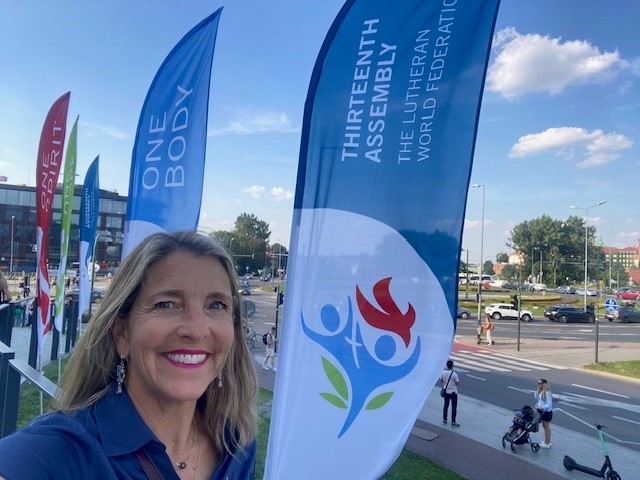
We are two days into the 13th Assembly of the Lutheran World Federation, and I am having a great time. It is wonderful to be meeting so many people–old friends and new–and to see Wartburg grads, too, and make those connections.
Mostly, though, I am just trying to learn as much as I can: to find out about the concerns different member Churches [and individuals from those Churches] are sharing–both the challenges and the opportunities.
To that end, the first day we heard several different kinds of reports: reports from the geographic Regional Assemblies, and then reports from the Youth, Women and Men’s Pre-Assembly meetings. The report from the European Assembly talked about the challenges of climate refugees [in fact, all of the Regional Assemblies mentioned eco-theology and climate justice]. Interestingly, too, that representative mentioned the challenge of crafting a theology of peace when self-defense is necessary. [Remember that here in Krakow, we are less than a 2 hour drive to the Ukrainian border]. Several of the regional reports also mentioned the increase in “mental unhealth.”
It was also striking that there were very different reports on membership: in Africa, of course, membership in the Lutheran Churches is growing; in Asia, Christians continue to be an overwheming minority in almost all Asian countries; in Europe and the United States, membership is declining.
Also from the European report, there was an encouragement for Churches to “Address potentially dividing issues in courageous and respectful ways.” I liked that.
The Latin American & North American report [given jointly] used the metaphor of the sula. A Sula is “a place where rapid and heavy water streams collide together against rocks and uneven ground. These are beautiful and dangerous places. The overwhelming sound of the Sula represents the cries and groans in our context.” I was really struck by that image.
This year, there was an inaugural Men’s Pre-Assembly gathering, joining the Women and Youth Pre-Assemblies–that was interesting, and the men clearly appreciated the opportunity. [One delegate made a comment from the floor that there should be an Indigenous Pre-Assembly, too.] They shared the idea of “understanding our masculinity, there is another way, inspired by Christ’s humility,” advocating for a masculinity characterized by caring, nurturing, and serving. This is clearly a lovely sentiment, but given the ongoing challenges with gender justice and women’s ordination in some of the LWF Churches, more work clearly needs to be done here.
The report from the youth was really inspiring, and they emphasized the need for “inclusive churches,” “youth leadership,” and “sustainable communities.” They also called on the LWF to “create a statement regarding the need to use inclusive and accessible language in communication and worship.” Yes, please!
I really loved the report from the LWF General Secretary, Rev. Dr. Anne Burghardt–she is amazing, and received a standing ovation. She noted that gender-based violence increased by 40% around the world, and was called a “shadow pandemic.” We are still fighting against that increase, and its fallout.
She also said that while Christians say that “perfect love casts out fear,” in fact, sadly, the reverse also can be true: fear can cast out love–love of God and love of neighbor. I think all of us have seen that in action.
She talked about the global refugee crisis: displaced people have topped more than 100 million for the first time in history. At the same time, she emphasized that all around the world, Lutheran Churches are playing a significant role in responding to these challenges; in her view, there is a good synergy between the local Church bodies and the LWF. She noted that the work of LWF supports 3 million refugees around the world, going many places where other aid groups will not go. She mentioned the Nigerian refugees in Cameroon who are fleeing Boko Haram as an example.
She acknowleged the importance of supporting women and women’s ordination in all LWF Churches, even though that isn’t a reality yet. Related to this, she emphasized the commitment to gender justice, and talked about holding the tension between affirming the dignity of every human being created in love and called good by God, and respecting differences of opinion on family structure, marriage and human sexuality. Personally, I wonder if that balance actually can hold.
Two final observations. First, worship has been really fun and interesting, and I have appreciated the use of a variety of hymnody and languages. Second, Krakow is gorgeous, and the representatives from the Lutheran Church in Poland have been amazing hosts. They represent only 1% of the population, and there is only one Lutheran congregation in the entire city of Krakow [where you are virtually always in the sightline of at least one Catholic church]; AND, they, of course, have been helping support millions of Ukrainian refugees at the same time they were organizing the on-the-ground details of this larger and complex event. But, they are clearly happy we are here, and it has been wonderful learning more about their rich culture and history.
It has been a fantastic experience, and I am so grateful to be here, learning more about how God is active in the church for the sake of the world in so many different forms around the world.

 Happy Lutheran