

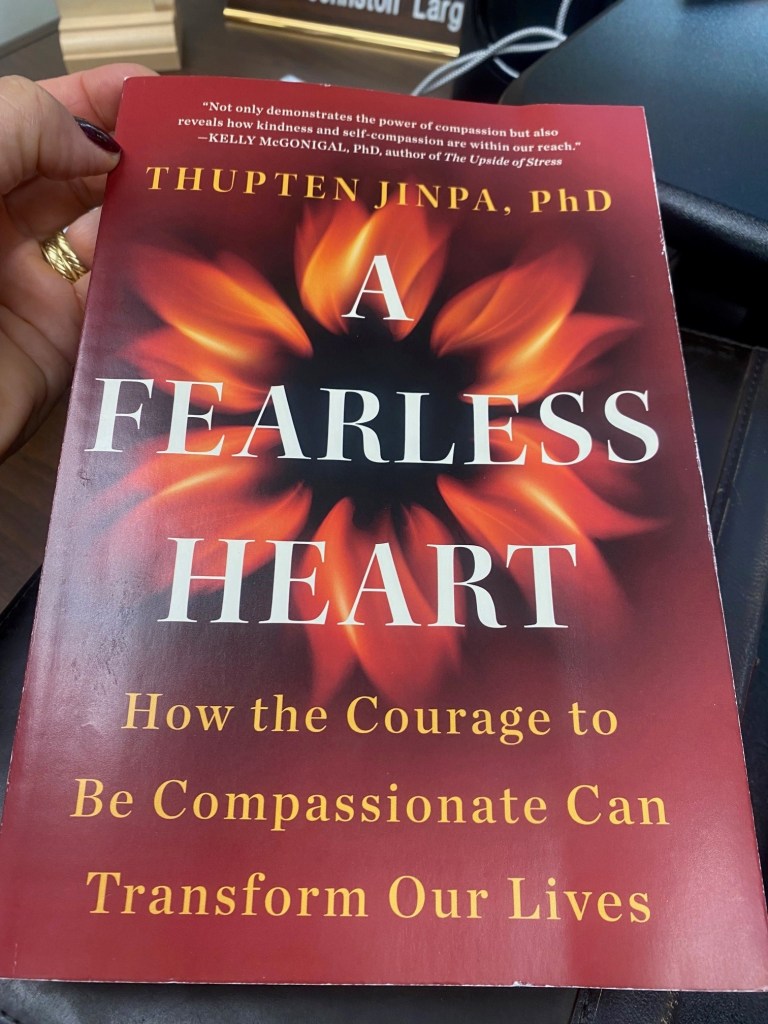
I wanted to share just a few brief reflections on this book, which, as you can see from the title, focuses on the transformative power of compassion–and how a life grounded in compassion can change not only our own outlook on things, but also can change our institutions: he mentions our educational systems, health care, workplace, etc.
Jinpa is a former Tibetan monk, and he was an English translator for the Dalai Lama for many years. He draws upon that experience, and his observations of the Dalai Lama throughout the book. He also shares many concrete practices from Buddhism, mostly different kinds of meditation and mindfulness practices, that can deepen one’s “practice” of compassion.
I liked the book, primarily because I really agree with two ways he talks about compassion: first, as an orientation and a way to frame how you engage the world and others. Sometimes we just limit our use of compassion to an adjective–this or that person is very compassionate. In the book, he almost uses it as a verb–an active way of living that foregrounds care, kindness and courage. [The “courage” part is especially important; compassion actually enables us to speak up for ourselves and for others–to be honest even when it is hard and uncomfortable, for the sake of positive change.] And, in that way, compassion is something we can “practice”–a skill or habit we can develop. The more we live our lives through that lens, the more natural that way of being becomes–and that’s when the transformation happens. He gives many examples of people who have gone through “compassional cultivation training [CCT]” [find out more about that here: https://www.compassioninstitute.com/cct/] and what a difference that makes in their lives, and in the lives of those with whom they live and work.
So, just a few quick points from the book.
He spends a good chunk of time talking about self-compassion, which I also really appreciated, because sometimes people think that being compassionate means always putting oneself and one’s own needs last. By contrast, he argues that being compassionate to others necessitates being compassionate to oneself–you can’t have one without the other. He describes the three main components of self compassion as self-kindness [relating to our own shortcomings with understanding rather than negative judgment], common humanity [setting our own problems and suffering in the larger context of shared human experiences], and mindfulness [holding painful experiences in awareness and approaching our own feelings with curiosity and openness].
He also describes the benefits of self-compassion this way: it enables us to renew our resources— replenishing a wellspring of kindness and compassion that lies within and recharging our inner battery. It heps us set realistic goals–goals that are more personally meaningful and more doable. It helps us to learn from our experiences, which means we are less likely to get stuck in self-judgment, and allows us to be more encouraging and less afraid of our mistakes. Finally, it helps us to feel less alone, and supports our being kind and happy.
Last thing. He names “six essential features of positive psychological functioning” [182], and, of course, argues that being more compassionate furthers these characteristics. I thought they were interesting in and of themselves; as you look at the list, how would you rate yourself/your life in these areas?
- Self-acceptance: having a positive attitude toward ourselves
- Positive relation with others: social connectedness, having warm personal relationships
- Autonomy: points to our ability to regulate our behavior from within, rather than by external constraints; resisting social pressures to think/act certain ways
- Environmental mastery: a kind of competence in the ability to choose or create contexts suitable to personal needs and values [this is an interesting idea I’m still thinking about–it clearly points to one’s ability to actively create one’s environment–emotional, physical, intellectual, etc., rather than just passively accepting conditions set by others]
- Purpose in life: having goals and a sense of direction
- Personal growth: being open to new experiences and being committed to realizing one’s potential
It’s a good book and an easy read, and we all can do with more compassion in our lives!

 Happy Lutheran